
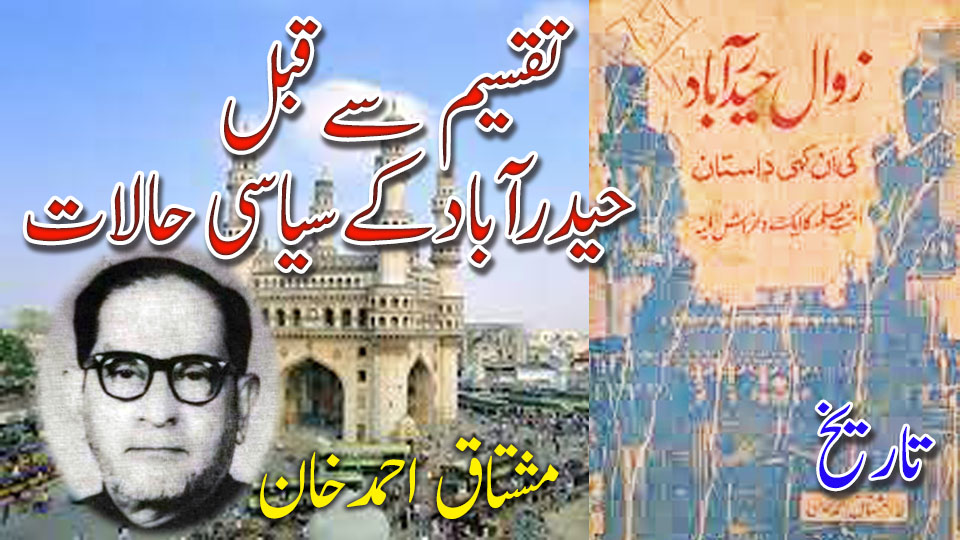
The Political Situation in Hyderabad: Ottoman Empire was the last sign of Muslim ascendancy in the world, beginning in Turkey and ending in Hyderabad, Deccan. Its decline had many causes, a discussion of which is lengthy and only useful if it is undertaken with the intent to learn from it rather than merely recount it. The conversation about these causes is significant, especially if the aim is to protect future generations from repeating the same mistakes. In Urdu literature, numerous books have been written on this subject, many by witnesses of the era, those who lived through the events they narrate. One such witness was Nawab Mushtaq Ahmad Khan, who served as the Finance Minister of Hyderabad during the reign of Mir Osman Ali Khan. His two books, “Karwan-e-Hayat” and “Zawal-e-Hyderabad,” are particularly important.
The Rise and Fall of Muslims in Southern India
Zawal-e-Hyderabad is divided into three parts. The first part focuses on the rise and fall of Muslims in Southern India and the establishment of the Asif Jahi dynasty. In this section, Nawab Mushtaq Ahmad Khan discusses the decline of the Ottoman Empire and its impacts, particularly on the political landscape of Muslims in Hyderabad, Deccan. He provides a detailed account of the reasons behind the formation of the Asif Jahi dynasty and the efforts made during its establishment.
These conditions not only gave Muslims in Hyderabad a unique position in governmental matters but also internationally. He also emphasized how the fall of the empire left Muslims vulnerable to security risks and economic and political losses.
Diplomatic Relations and Hyderabad’s Foreign Embassies
Hyderabad’s political condition: The second part of the book revolves around the foreign policy and diplomatic efforts of the Hyderabad state. Here, the author discusses the establishment of foreign embassies and the role they played in international relations during the period. Nawab Mushtaq Ahmad Khan also shares the story of his father, Fakhru’d-Din Ahmad, who was part of these diplomatic efforts as the Finance Minister.
In this section, he highlighted the negotiations and diplomatic relations Hyderabad had with different states, especially with the outside world. Hyderabad formed several treaties and diplomatic relationships to safeguard its economic and political interests. This period was critical in shaping Hyderabad’s external affairs, and the book provides a comprehensive analysis of the challenges faced in this regard.
The Fall of Hyderabad and Its Aftermath
Political Situation in Hyderabad: The third and final part focuses on the aftermath of Hyderabad’s fall. Here, the author discusses the case presented at the United Nations and the impact on the people of Hyderabad. Nawab Mushtaq Ahmad Khan provides a detailed analysis of the political and economic reasons behind the fall, including the changes in foreign policy and internal instability.
He also discusses how attempts to present the case at the United Nations failed and the resulting turmoil in the state. This section further describes the social and economic challenges faced by the people of Hyderabad after the fall, such as unemployment, losses, and the struggle to maintain social stability.
Conclusion
Political Situation in Hyderabad: The video excerpt from Nawab Mushtaq Ahmad Khan’s book provides a detailed account of Hyderabad’s political situation. This book remains a valuable guide, offering a lesson that we need to learn from history and work towards creating a safe and progressive society.
The events and observations detailed in this book are still relevant today, reflecting not only the political conditions of Hyderabad but also those in other parts of India. The book serves as a reminder of the importance of balanced international relations and domestic stability in safeguarding any state from crises.
Lessons from the Past
Political Situation in Hyderabad: Nawab Mushtaq Ahmad Khan’s book “Zawal-e-Hyderabad” teaches us about the consequences of an imbalanced foreign policy and the lack of internal political stability in Hyderabad. It highlights how these factors contributed to the instability and eventual fall of the state. His analysis also shows the difficulties Muslims faced in Hyderabad after the fall, and how they tried to safeguard their interests in a changing environment.
The book provides insight into the complex interplay of internal and external policies that led to Hyderabad’s decline. It is a valuable document not only for understanding Hyderabad’s past but also for comprehending the broader political scenario in India and the challenges faced by other Muslim-majority states.
Zawal-e-Hyderabad remains a crucial document today, leaving behind a legacy that we must learn from and apply to build a safer and more stable society. The insights and observations contained in this work are critical for anyone looking to understand the political dynamics of the region and the impact of historical events on contemporary settings. By studying the past, we can avoid repeating the same mistakes and create policies that ensure both internal stability and effective international relations.
If you’re interested in reading this book, click the link below for a free download.
https://drive.google.com/file/d/1UdN7JR9hfYVoSXV55xmTq3YsvupOFjWL/view?usp=sharing
If you’d like to listen to this book in audio format, click the CONTACT button below to get in touch with the AwazeUrdu team to order the audiobook.
Click the link below to watch the video on Facebook as well. https://www.facebook.com/share/v/18gZr31QQv/
Click the link below to watch the video on Rumble as well.
https://rumble.com/v5ylwp8-the-political-situation-in-hyderabad.html